South Africa is one of the most relevant African markets for local pet food manufacturing discussion. Mordor Intelligence estimates the South Africa pet food market at about 800 million USD in 2026 and projects it to reach about 1.33 billion USD by 2031, with a forecast CAGR of about 10.72%.
Official macro data also supports the urban-channel angle. World Bank reports South Africa's urban population at about 63.7% of total population in 2024. That context matters because pet food demand is usually easier to organize through urban retail, distribution and online repeat-purchase channels.
For established distributors, feed companies and investors, the opportunity is not only domestic sales. A properly planned factory may also support selected Southern Africa distribution routes. Xinji Pet Food can help evaluate this path from formula, factory flow, QC and commercial execution, based on more than 20 years of pet food production and supply experience.
1. Why local manufacturing deserves evaluation
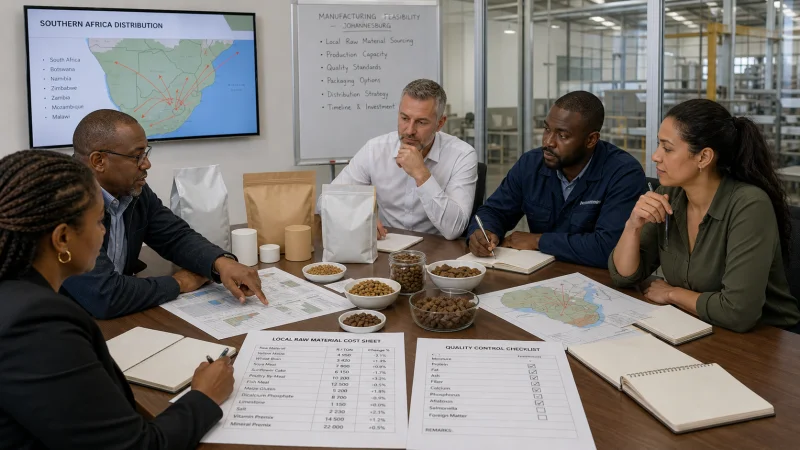
South Africa has a more developed retail and distribution structure than many nearby markets. That creates room for dog food and cat food ranges with clear price tiers, stable packaging and repeat supply. Local manufacturing can reduce some supply-chain pressure, but only if raw material planning and quality control are realistic.
Companies still validating demand can continue through dog food suppliers, cat food suppliers, pet food distributors and wholesale pet supplies before moving to a plant investment decision.
2. Start from product-market fit
A pet food production line must match formula type, production volume, drying capacity, coating system, packaging format and QC standards. Buying equipment first can lock the project into a process that does not match the intended product. The right starting point is adult dog food, puppy food, adult cat food, kitten food, value line, mid-range line or private label range.
South Africa also needs clear price-tier planning. A premium product may require stronger ingredient positioning and packaging, while a value product must be built around stable raw material cost and efficient production. Each route leads to a different formula and different capital plan.
3. Raw materials and cost stability
Local raw material availability is a major advantage only when quality, price and supply continuity are verified. The plan should check protein meals, cereals or starch sources, fats, palatants, premix, packaging films and cartons. A factory should also identify substitute suppliers before commercial launch.
Because pet food margins can be sensitive to raw material swings, the business model should test several cost scenarios. It is better to discover margin pressure during planning than after the production line is installed.
4. Equipment and process flow
A dry pet food factory normally includes raw material receiving, grinding, dosing, mixing, extrusion, drying, coating, cooling, screening, packing and warehousing. The process must be designed around target output, shift plan, energy use, operator skill, QC points and cleaning procedure.
Dryer capacity, coating accuracy and packing speed often create practical bottlenecks. The equipment list should therefore be evaluated as a complete system, not as separate machines.
5. QC builds distributor trust
South African distributors and retailers need stable products. QC should monitor moisture, kibble size, color, coating level, palatability feedback, packaging seal, retained sample and warehouse conditions. Complaint handling and batch traceability are especially important when serving multiple regions.
Good QC records also support private label development and regional export discussions. They show that the factory can repeat a product, not only make one successful trial batch.
6. Regional distribution should be planned early
If the factory aims to serve Southern Africa, the plan should consider packaging language, carton strength, shelf life, distributor credit terms, lead time and logistics cost. Regional ambition is valuable, but it should not distract from building a stable domestic base first.
7. Investment stages
A staged approach is safer: validate demand and formula, run pilot or smaller production, secure repeat orders, then expand capacity. Key indicators include cost per kilogram, monthly output, inventory turnover, complaint rate, distributor reorder rate and gross margin. These indicators are more useful than nominal machine capacity alone.
8. Where Xinji's experience fits
Xinji can support the early project stage by helping connect formula targets, production process, sample testing, QC logic and sales-route planning. The goal is to help local teams build a workable factory plan before committing to large-capacity investment. Teams focused on brand ownership can also compare private label pet food before deciding on full manufacturing.
Companies evaluating a South Africa project can send details through Pet Suppliers ZA, including category focus, intended location, expected capacity, channel coverage and raw material assumptions.